I bought the dead Tacoma for parts, but the first thing I found under the hood made me stop touching it.
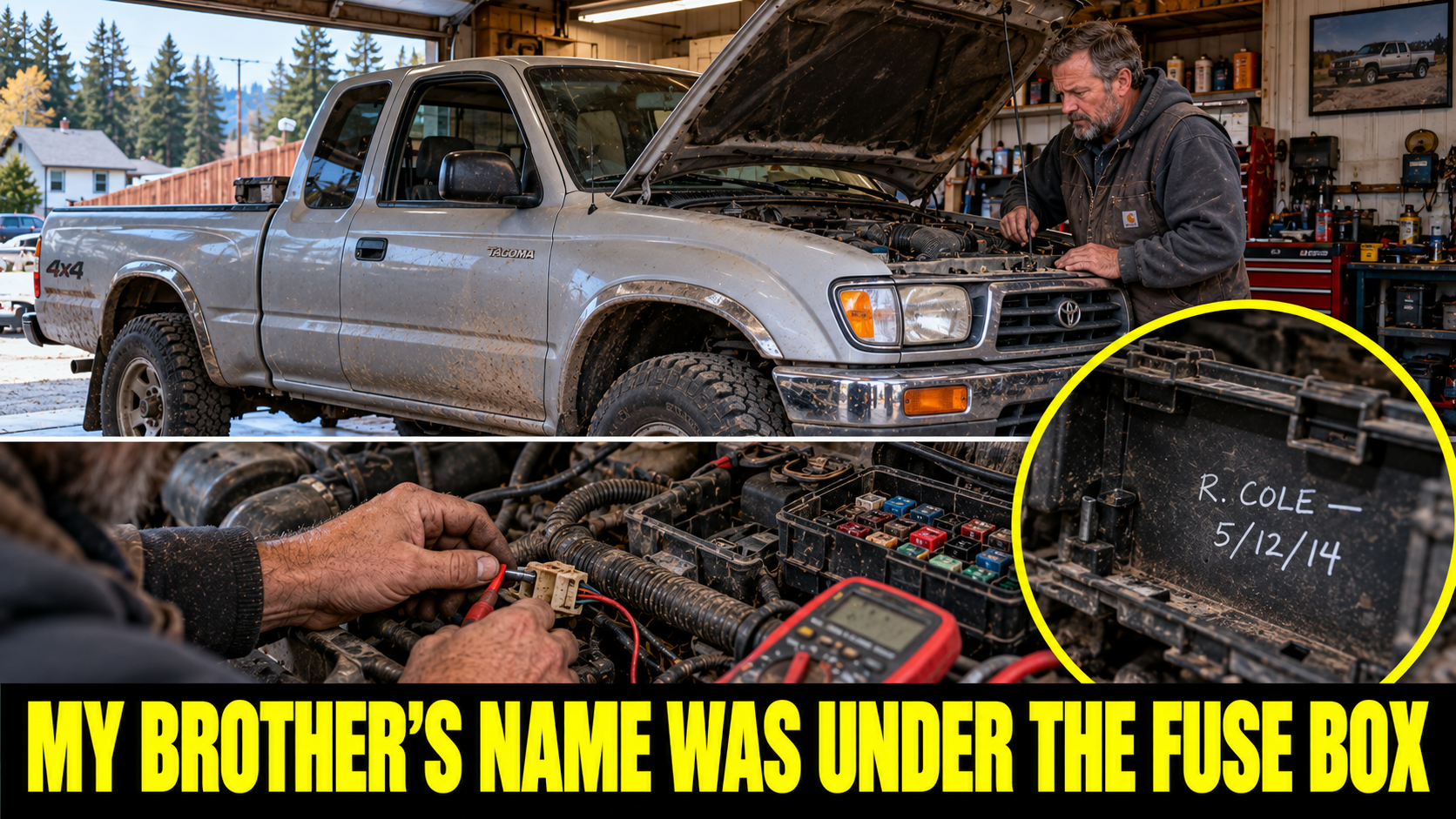
The truck was a faded silver 1997 Toyota Tacoma 4×4 sitting behind a small body shop outside Spokane, Washington. It had a five-speed, a tired gray interior, peeling clear coat, and enough pine needles packed below the windshield to prove it had spent years outside.
The owner of the shop told me it had been parked for six years after an electrical problem nobody wanted to chase. The engine still turned over. The frame was usable. The transmission was supposed to be good.
I paid $900 because I needed the manual transmission and several interior pieces for another Tacoma project.
I wasn’t trying to save it.
My younger brother Ryan probably would have argued with me about that.
Ryan had been the Toyota guy in our family. He could spend an entire Saturday repairing a twenty-year-old pickup and somehow come home happier than somebody who had bought a new one. Eight years earlier, we lost him after a sudden illness. I still caught myself reaching for my phone when I found something mechanical he’d appreciate.
I hauled the Tacoma home on a trailer and backed it into my garage.
Before pulling parts, curiosity got me.
I installed a known-good battery and checked the obvious things. The starter cranked the engine strongly, but the EFI fuse opened almost immediately. I replaced it once with the correct rating, watched it fail again, and stopped.
Repeatedly feeding fuses into a short isn’t diagnosis.
I disconnected the battery and began inspecting the circuit.
The engine bay looked ordinary for an old Northwest truck. There was surface corrosion on brackets, brittle plastic in a few places, and evidence that several people had worked on it over the years.
I lifted the under-hood fuse and relay box so I could inspect the harness underneath.
That’s when I saw the writing.
On the lower edge of the plastic housing, almost hidden when the box was installed, somebody had written in white paint marker:
R. COLE — 5/12/14.
My last name is Cole.
My brother’s name was Ryan.
I stood there holding the box longer than I want to admit.
There are plenty of people named Ryan Cole. I knew that. Spokane isn’t a tiny town, and mechanics mark parts all the time.
Then I noticed an old repair pigtail tucked into the loom.
Ryan had a particular habit when he repaired wiring. He staggered his splices so they didn’t create one fat lump in the harness, then wrapped the finished section tightly before securing it away from sharp edges.
The repair in front of me looked exactly like his work.
I called Dad.
When I read him the date, he went quiet.
“Don’t cut that harness yet,” he finally said. “Ask them where that truck came from.”
I called the body shop.
The owner was patient enough to dig through an old paper folder. After several minutes, he found a previous owner’s name: Walter Hayes.
I knew it immediately.
Walter had worked with Dad years earlier at a building-supply warehouse. I remembered him coming to family cookouts when Ryan and I were younger.
Suddenly the Tacoma wasn’t just a random $900 parts truck.
Dad remembered more than I did.
In 2014, Walter had called Ryan about an intermittent no-start on a silver Tacoma. Ryan spent most of a Saturday helping him in Dad’s driveway. Dad remembered because they missed dinner waiting for the truck to fail again.
According to Dad, Ryan eventually found damaged wiring near the fuse box, repaired it, and got Walter back on the road.
I asked the question that had been bothering me.
“Did Ryan own this truck?”
“No,” Dad said. “But he worked on it. I’m almost sure that’s the one.”
That changed my plan.
Instead of removing the transmission, I rolled my electrical cart beside the Tacoma.
First I found the proper wiring information for the truck. Then I isolated branches of the EFI circuit rather than guessing.
With the battery disconnected, I checked the harness carefully for continuity to ground where it shouldn’t have been present.
The short was real.
I separated connectors one at a time, watching the meter and narrowing the circuit.
Eventually the problem led me toward a section of loom running near the inner fender.
The old repair that looked like Ryan’s work was still intact. Its connections had held up remarkably well.
But several inches farther down, the loom felt stiff.
I opened it carefully.
Underneath was a second repair.
This one wasn’t Ryan’s.
Two wires had been joined with an unsealed crimp connector. The insulation around the repair had hardened. Moisture had worked its way inside, and corrosion had traveled beneath the insulation.
Worse, the harness had been routed against the edge of a metal bracket.
Years of vibration had worn through the protective loom and then through the insulation on one wire.
When the wire shifted against the bracket, it shorted to ground and opened the EFI fuse.
That explained the failure.
But it didn’t explain why Ryan’s name was on the fuse box.
Dad drove over that afternoon.
He walked into the garage carrying an old red toolbox Ryan had used as a teenager.
For a minute he didn’t say anything.
Then he leaned over the fender and looked at the paint-marker writing.
“That’s his,” he said.
I asked how he could be sure.
Dad opened the toolbox and pulled out an old socket organizer. On the bottom, Ryan had written his name in the same blocky letters.
The R leaned forward. The C was almost square.
It matched.
Dad smiled, but his eyes were wet.
“He marked everything he touched back then,” he said.
We stood there in the garage with the Tacoma between us.
I had bought the truck to dismantle it.
Now neither of us wanted to.
The next morning I repaired the damaged section properly.
I removed the corroded wire far enough back to reach clean copper. I replaced the compromised section with the correct gauge wire, made sealed repairs, restored the protective loom, and secured the harness so it couldn’t contact the bracket again.
Before installing another fuse, I checked the circuit again.
The unwanted path to ground was gone.
I installed the correct fuse and reconnected the battery.
The Tacoma cranked.
Then it started.
The engine stumbled for a few seconds after sitting so long, then settled into an uneven idle.
I laughed loud enough that my wife came out to the garage.
“You’re supposed to be taking that thing apart,” she reminded me.
“I know.”
She looked at Dad, then at Ryan’s writing.
“Oh,” she said.
That was the end of the parts-truck plan.
Getting it running was only the beginning.
A vehicle parked for six years doesn’t become roadworthy because the engine starts.
I inspected the brakes, tires, steering, cooling system, fuel system, belts, hoses, fluids, and chassis before even thinking about driving it.
The tires were too old to trust.
One front caliper was dragging.
The brake fluid looked terrible.
The fuel smelled stale, and the tank needed attention.
The timing and maintenance history were uncertain enough that I treated the truck like an unknown vehicle rather than assuming Walter had kept records forever.
Over the next several weekends, Dad and I worked through it.
We weren’t building a show truck.
We were making an old Tacoma safe and dependable again.
We replaced worn service items, cleaned years of dirt from places nobody sees, repaired a torn seat seam, and left most of the faded paint alone.
Dad insisted on keeping the crooked little dent in the tailgate.
“Walter put that there backing into my utility trailer,” he said.
I hadn’t remembered that either.
Every few days, another small piece of the truck’s history came back.
Eventually I tracked down Walter through an old number Dad still had.
He was living in Idaho.
When I told him which truck I’d bought, he laughed.
“That thing is still alive?”
“Barely.”
Then I asked about Ryan.
Walter remembered the 2014 repair immediately.
He said the Tacoma had died intermittently for weeks. Two shops had looked at it without catching the problem because it behaved normally whenever it arrived.
Ryan wasn’t working as a professional mechanic then. He simply liked electrical problems and refused to let the truck beat him.
Walter said Ryan found a damaged section beneath the fuse box, repaired it, and wrote his name and the date underneath so he’d know where he’d been if the problem ever returned.
For years, the Tacoma ran normally.
The later damaged repair, Walter explained, probably happened after he sold the truck. He didn’t recognize the second splice I described.
Ryan’s repair hadn’t failed.
A different repair farther down the harness had.
A month after I bought the Tacoma, Dad and I took it on its first proper road test.
I chose a quiet route north of Spokane with enough distance to bring everything to operating temperature without getting too far from home.
I watched the gauges like a nervous parent.
The truck shifted cleanly.
The temperature stayed steady.
No fuse opened.
No warning light appeared.
At a gas station, Dad walked around the truck and rested his hand on the fender.
“Ryan would’ve bought this stupid thing,” he said.
I laughed.
“He would’ve paid too much.”
“Absolutely.”
That was the first time we’d joked about him in a while without the room becoming quiet afterward.
I eventually finished the other Tacoma project without using a single part from the silver truck.
That cost me more money, but I didn’t care.
The 1997 stayed.
I cleaned the underside of the fuse box carefully, but I didn’t touch the white paint marker.
R. COLE — 5/12/14 is still there.
The most useful mechanical lesson from the truck wasn’t sentimental.
Electrical shorts should be isolated systematically. A blown fuse is protection doing its job. Installing larger fuses or repeatedly replacing the correct fuse without finding the fault can damage wiring or create a fire risk.
I had disconnected the battery before opening the harness. I used wiring information to understand the circuit, isolated branches rather than cutting randomly, and repaired the damaged wire only after finding the actual contact point.
The second lesson was just as important: never assume the oldest visible repair is the failed repair.
Ryan’s work looked suspicious because it was old and obvious.
It wasn’t the problem.
The failure was farther down the harness, where a later unsealed splice and poor routing had allowed corrosion and abrasion to create a short.
If I had blamed the first repair I saw, I might have fixed something that wasn’t broken and missed the real fault.
The emotional lesson took me longer.
For eight years, most things connected to Ryan had been photographs, tools, and stories we’d already told.
The Tacoma was different.
It was evidence of an ordinary Saturday when he helped somebody get home.
Not a dramatic event.
Not something he expected anyone to remember.
Just a repair done carefully enough to outlast him.
Dad still comes over when I work on the truck.
The paint is still faded. The interior still smells like an old pickup. The tailgate still has Walter’s dent.
And every time I open the hood, I know exactly what’s under that fuse box.
I bought a $900 Tacoma because I wanted its transmission.
Instead, I ended up repairing a truck my brother had once repaired himself.
The best part wasn’t discovering his name.
It was discovering that fourteen characters in white paint marker could turn a pile of spare parts into something my family wanted to keep.
Story note: This is an original dramatized automotive story created for entertainment.