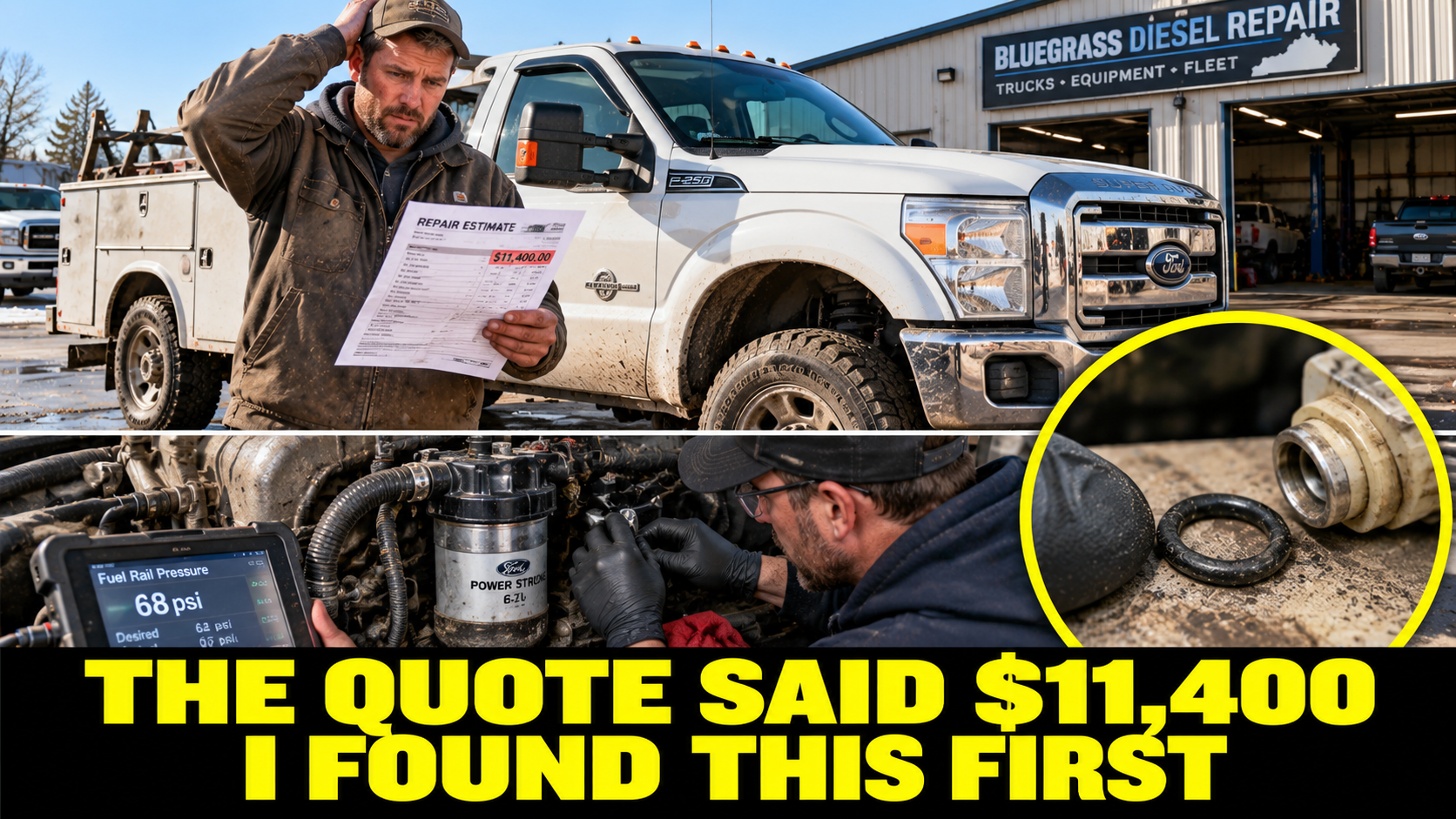
The estimate on my counter said $11,400, and the owner of the F-250 looked like he hadn’t slept all night.
What bothered me was that his truck had driven into my shop under its own power.
The truck was a white 2015 Ford F-250 Super Duty with a 6.7-liter Power Stroke, about 168,000 miles, a steel utility bed, and the scratches you’d expect from years of fence work around Bowling Green, Kentucky.
Its owner, Caleb Morris, was forty-one and self-employed. He built farm fence, repaired gates, and hauled a skid steer often enough that his truck wasn’t just transportation. It was part of his paycheck.
He slid a printed estimate across my counter. Another shop had warned him that his symptoms could point to expensive high-pressure fuel-system trouble. The estimate showed what a broad repair could cost if major component damage or contamination was confirmed.
“I’m not saying they’re wrong,” Caleb said. “I just can’t spend eleven grand on a maybe.”
I told him I couldn’t promise a cheap repair either.
Modern diesel fuel systems can become expensive quickly. If a high-pressure pump fails internally and spreads metal through the system, pumps, injectors, rails, lines, cleaning, and labor can turn into a painful bill.
But an expensive possibility isn’t the same thing as a diagnosis.
Caleb’s complaint was specific. The F-250 started normally and idled smoothly. Empty, it usually drove around town without drama. With his equipment trailer attached, it lost power on longer grades. Twice it had displayed a warning and reduced power.
The problem had become worse over two weeks. Caleb had already canceled two jobs because he was afraid a questionable truck would become a dead truck thirty miles from home.
I started by scanning the relevant modules and recording the stored codes instead of clearing them.
Then I watched live data.
At idle, commanded and actual rail pressure didn’t give me a reason to condemn the high-pressure system. That didn’t prove it was healthy, but it mattered.
I inspected the fuel filters and asked when they had been changed. Caleb had receipts from about four months earlier. They weren’t unknown bargain parts.
Next came the basic visual inspection and low-pressure supply checks.
Diesel problems can tempt people into staring at a scan tool while ignoring the wet fitting right in front of them.
After cleaning the area around the fuel-filter housing, I ran the truck again. A faint wet line appeared around one connection.
From above, the fitting looked seated.
I shut the engine down and made the system safe before opening anything. When I inspected the connection, its sealing O-ring was flattened and nicked.
The individual seal cost about thirty-eight cents.
Caleb saw it on my bench.
“That’s it?” he asked.
“No,” I said.
His face fell.
I explained that we’d found a real fault, but a real fault isn’t automatically the only fault. His loaded power-loss complaint still had to be reproduced after the repair.
We installed the correct seal, seated the connection properly, cleaned the area again, and checked for leakage.
Dry.
Then I drove the truck around town. It felt fine.
That proved almost nothing, because Caleb had already told me it behaved around town.
We arranged a controlled loaded test, staying within safe operating limits. I connected the scan tool and recorded the relevant fuel-system data.
On a grade outside town, the truck pulled normally at first.
Then the low-pressure fuel supply began to fall. The high-pressure side followed because it couldn’t get what it needed.
I turned around.
Back at the shop, Caleb was waiting.
“The O-ring didn’t fix it?”
“It fixed a leak,” I said. “It didn’t fix everything.”
That distinction kept us from celebrating too early.
I reopened the filter housing for inspection. At the bottom was fine debris.
It wasn’t shiny metal.
That was important.
The material looked more like contamination from the supply side than obvious evidence of catastrophic high-pressure pump damage. I collected a clean sample and inspected it carefully.
There was dirt and dark material, but I wasn’t seeing the metallic evidence that would have immediately pushed the diagnosis toward Caleb’s nightmare scenario.
Then we checked farther back through the supply path.
The restriction became more obvious as demand increased. Testing eventually led us toward the fuel tank and pickup side.
When we inspected the tank, we found the next clue: contamination had collected around the pickup and was restricting flow when the engine demanded more fuel.
Caleb stared at the material in the drain pan.
“How does that even happen?”
There wasn’t a dramatic answer.
He occasionally fueled from job-site tanks. His truck had lived a working life in dusty places. Dirt and water can enter fuel systems in ordinary ways, especially around equipment and portable storage.
The important question wasn’t who to blame.
It was whether the contamination had damaged the expensive high-pressure components.
That was the test that mattered.
We cleaned the contaminated supply side properly instead of simply throwing another filter at it. We serviced the affected components, installed appropriate filters and seals, verified clean fuel delivery, and repeated our pressure checks.
Then I inspected the samples again for evidence of metal.
Still no sign of the kind of metallic contamination that would justify selling Caleb an entire high-pressure fuel system based on what we had found.
I told him exactly that.
“I can’t promise any diesel component will last forever,” I said. “But I don’t have evidence to sell you an eleven-thousand-dollar repair today.”
He leaned against my toolbox.
“So what do I owe you?”
The total for diagnosis, cleaning, filters, seals, fuel-system service, and labor came to a little under $1,100.
That wasn’t thirty-eight cents.
And that’s important.
The cheap O-ring makes a great headline, but it didn’t magically repair the whole truck. It was the first physical clue.
The real job required hours of diagnosis, cleaning, inspection, parts, road testing, and verification.
A week later, Caleb returned after several fence jobs. He had hauled the same trailer over the same roads where the truck had previously lost power.
No reduced-power warning. No hesitation. No fresh leak.
We scanned it again and reviewed the data. Everything remained where it should.
Caleb handed me the folded original estimate.
“I almost signed this,” he said.
I reminded him that the other estimate wasn’t automatically dishonest. A shop may discuss a worst-case repair when symptoms suggest possible high-pressure contamination, particularly before enough testing has ruled it in or out.
What matters is whether the evidence supports the repair before the customer authorizes it.
Caleb nodded.
“I just wish somebody had explained it like that.”
That sentence stayed with me.
Customers hear a large number and often assume one of two things: either the vehicle is ruined, or the shop is trying to rob them.
Real diagnosis is usually less dramatic.
Sometimes an $11,000 repair really is necessary. Engines fail. Pumps fail. Injectors fail. Contamination can spread.
Other times, a similar symptom can begin with restricted supply, damaged wiring, a sensor problem, contaminated fuel, or a leaking seal.
The price of the suspected component doesn’t tell you which answer is correct.
Testing does.
Caleb’s F-250 offered several useful lessons for diesel owners.
First, don’t ignore symptoms that appear only under load.
A truck that idles perfectly can still have a fuel-delivery problem. At idle, demand is low. A restriction may not become obvious until the truck is climbing a grade, towing, or accelerating.
Second, maintenance history matters.
Knowing when the filters were changed and what parts were used gave us useful context. It didn’t eliminate contamination, but it stopped us from guessing blindly.
Third, a visible leak deserves attention, but finding one fault shouldn’t end the diagnosis if the original complaint hasn’t been verified as fixed.
The O-ring was damaged. Replacing it was correct.
If I had handed Caleb the keys immediately afterward, the truck would have gone right back to losing supply pressure under load.
Fourth, contamination needs to be identified, not merely feared.
Evidence of metallic debris associated with a failing high-pressure component is a very different situation from dirt or other contamination on the supply side. Repair decisions can be completely different.
Finally, when you’re facing a huge estimate, ask what testing supports it.
That doesn’t mean arguing with the technician or demanding a cheap answer. It means understanding what was measured, what was observed, what is confirmed, and what remains a possibility.
A useful second opinion isn’t somebody promising to beat the first price.
It’s another qualified diagnosis.
About a month later, Caleb stopped by for an unrelated bulb. He had his equipment trailer behind him.
The F-250 was dirty, the utility bed was full of fencing tools, and a roll of wire was strapped against the headache rack.
In other words, it was back at work.
He told me he’d put nearly three thousand miles on it since the repair.
Then he laughed.
“I still have that little O-ring.”
Apparently he’d taken it from my bench when he picked up the truck.
“Why keep that?”
He shrugged.
“Most expensive thirty-eight-cent part I’ve ever seen.”
I understood what he meant, but I corrected him anyway.
The O-ring wasn’t important because it was cheap.
It was important because it made us keep looking.
Its failure showed that the fuel supply deserved closer attention. The loaded test proved the first repair wasn’t enough. The debris in the housing moved us farther upstream. The tank inspection explained why increased demand made the truck fall on its face.
Each clue led to the next one.
That’s what diagnosis is supposed to look like.
Not guessing the cheapest possibility.
Not automatically choosing the most expensive possibility.
Follow the evidence until the original complaint has an explanation, then prove the repair under the same conditions that caused the problem.
Caleb’s truck didn’t need an $11,400 fuel-system overhaul.
It also didn’t need only a thirty-eight-cent O-ring.
It needed a real diagnosis, a contaminated supply system cleaned correctly, and enough verification to know we weren’t sending a working man back onto the highway with a guess.
For Caleb, that difference meant keeping thousands of dollars in his business account and getting back to the jobs that paid his bills.
For me, it was another reminder that the number printed at the bottom of an estimate should come after the evidence, not before it.
Story note: This is an original dramatized automotive story created for entertainment.
Before Caleb left, I also showed him how I wanted him to treat the next warning light. Don’t keep towing through a new loss-of-power complaint just because the truck still moves. Write down when it happens, whether the engine is hot or cold, how much fuel is in the tank, whether a trailer is attached, and what the dash displays. Those details can shorten diagnostic time because they help a technician reproduce the failure instead of waiting for it to appear by luck.
I also recommended keeping fuel receipts and service records with the truck. On a working diesel, documentation isn’t paperwork for paperwork’s sake. It helps separate recent maintenance from unknown history and gives the next technician a better starting point. Caleb put a small folder behind the rear seat that afternoon.