Mike Dalton had already lost about $2,100 in scheduled excavation work when he pulled his 2016 Chevrolet Silverado 2500HD into my shop outside Knoxville, Tennessee.
Then he handed me an estimate showing a possible repair total of $12,600.
“Would you put that much money into this truck?” he asked.
Before I answered, I asked him a different question.
“Has anybody proved it needs that repair?”
That was where the story started.
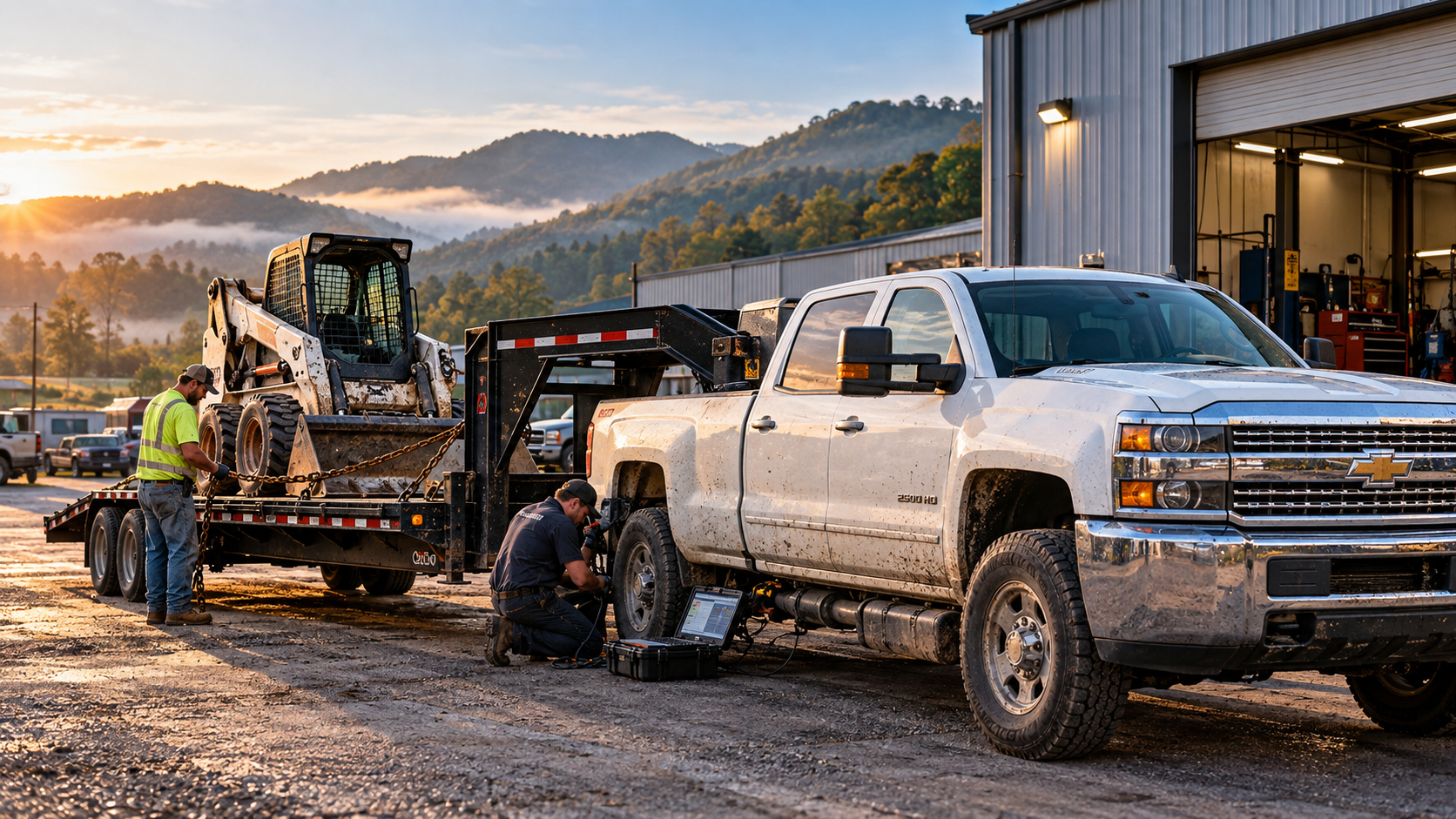
Mike’s Silverado had 238,000 miles on it and a 6.6-liter Duramax diesel. It was not polished, lifted, or built for parking-lot attention. The driver’s seat was worn, the bed had dents, and the receiver hitch showed exactly what the truck did for a living.
Mike owned a small excavation business.
The Silverado pulled a gooseneck trailer carrying a compact skid steer, attachments, pipe, and whatever else a job required.
When the truck worked, Mike worked.
When the truck sat, invoices stopped going out.
The first failure happened on a grade with the trailer loaded.
Mike pressed into the throttle and felt the engine flatten out.
The truck did not shut off. It simply stopped pulling the way it should.
A warning appeared. Reduced-power behavior followed.
He eased off, got to a safe place, and eventually made it home without the trailer.
The next morning, the Silverado started normally.
Around town, unloaded, it felt almost fine.
That confused him.
A few days later he tried towing again.
Same problem.
Under sustained demand, power disappeared and fuel-rail pressure could not keep up.
The first shop did not invent the concern. They found a low fuel-rail-pressure fault and explained that modern diesel fuel systems can become extremely expensive when a high-pressure pump fails internally and sends contamination through injectors, rails, lines, and the rest of the system.
Their paperwork outlined a worst-case repair path.
Depending on what inspection revealed, the total could approach $12,600.
That number was enough for Mike to park the truck.
He canceled one job.
Then another.
By the time he reached me, he estimated that roughly $2,100 in work had already been postponed or lost.
That was gross business revenue, not pure profit. Fuel, insurance, equipment payments, taxes, labor, and operating expenses still existed.
But downtime was clearly costing him money.
The important thing was not to let that pressure turn diagnosis into guessing.
I explained three different numbers to Mike.
The first was a possible estimate.
The second would be an authorized repair after diagnosis.
The third would be the final invoice after the approved work was completed.
They might eventually be the same number.
They might not.
We began with the complaint exactly as Mike experienced it.
The truck started cleanly.
Idle quality was acceptable.
There was no dramatic knocking sound from the engine and no immediate cloud of smoke telling us where to look.
We checked stored faults and looked at relevant scan data.
The low-rail-pressure history supported Mike’s description.
Then we inspected the fuel filter and took a fuel sample.
I was looking for evidence of serious contamination, especially metallic debris that could support a high-pressure pump failure.
The sample did not hand us a five-minute answer.
That was good news, but it was not proof that the expensive components were healthy.
We installed test equipment and compared commanded fuel pressure with actual pressure.
At idle and under light operation, the numbers stayed close enough that somebody testing only in the bay might have struggled to reproduce the complaint.
That is why Mike kept saying the same thing.
“You have to put weight behind it.”
He was right.
Symptoms under load matter.
We arranged a controlled loaded test rather than abusing the truck on public roads.
As demand increased, commanded rail pressure climbed.
Actual pressure followed at first.
Then it began falling behind.
The gap became large enough to explain the reduced-power behavior.
Now we had reproduced the problem.
But we still did not know why pressure was falling.
A high-pressure pump that cannot meet demand is one possibility.
Injectors returning too much fuel can be another.
A restriction or supply problem before the high-pressure system can also starve the system when demand rises.
That last possibility mattered because one of our low-side readings did not look right.
At light demand, supply appeared adequate.
Under load, the behavior changed.
I stopped the test.
Back in the shop, we moved the test point.
That is a simple idea that can save a lot of money.
If pressure or vacuum changes depending on where you measure, you can begin isolating which section of the system is creating the restriction.
We tested again.
The result changed.
Now the evidence pointed farther upstream.
I opened the fuel filter housing and inspected it carefully.
There was contamination present, but it did not look like the metallic destruction Mike feared.
Instead, the pattern made me suspicious of what was arriving from the tank.
I called him over.
He looked into the housing and asked, “So that’s the problem?”
“It’s a clue,” I said.
That answer frustrated him.
He had already paid for diagnosis at another shop. He had already lost work. He wanted a part number.
But a clue is not a diagnosis.
If I had installed a new filter, cleared the code, and sent him towing, the truck might have made it ten miles before the same restriction returned.
We needed to inspect the supply path.
Mike authorized more diagnostic labor.
The tank came down.
That is where the story changed.
Debris had accumulated around the pickup area, and part of the supply-side assembly had deteriorated enough to restrict delivery under sustained demand.
At idle, the engine did not require enough fuel for the restriction to become obvious.
With a loaded trailer and the engine asking for far more fuel, the restriction mattered.
The high-pressure system was being asked to create pressure without receiving a stable supply.
That explained the pattern.
It did not automatically clear the expensive side of the system.
Running a high-pressure pump with inadequate supply can damage components.
We still had to determine whether Mike had caught the problem before that happened.
We inspected the fuel we removed and looked carefully for metal.
We checked the system according to the appropriate diagnostic process rather than declaring the pump good because we wanted a cheaper ending.
We addressed the tank contamination and replaced the deteriorated supply-side component.
The fuel filter was replaced.
The housing was cleaned.
The system was primed correctly.
Then we started the truck and checked for leaks.
At idle, everything looked good.
That meant almost nothing.
Idle was never the condition that failed.
Mike’s entire financial decision depended on the next step.
We needed to load the truck again.
The trailer was connected.
The test equipment stayed on.
We repeated the same kind of sustained pull that had previously caused actual rail pressure to fall away from commanded pressure.
This time the numbers tracked.
We increased demand carefully.
They continued to track.
The truck did not enter reduced-power mode.
We repeated the test after more heat had built into the system.
Still normal.
Only after the truck passed the loaded verification did I tell Mike that the evidence did not support replacing the complete high-pressure fuel system at that time.
His final bill was $2,740.
That included diagnostic labor, tank removal and cleaning, supply-side repair, filtration service, fuel-system cleaning work that was actually justified, reassembly, and loaded verification.
It was not a $50 miracle.
It was also not $12,600.
Mike stared at the invoice.
“So the other shop was wrong?”
I told him that was not how I would describe it.
They had identified a real low-rail-pressure problem and warned him about an expensive failure mode that absolutely can occur on diesel fuel systems.
Their five-figure number described what the repair could become if the high-pressure system was contaminated or damaged.
Our testing isolated a different confirmed cause before we authorized that repair.
There is a difference between a worst-case estimate and a dishonest estimate.
That distinction matters.
Mike then asked whether he should keep the truck.
At 238,000 miles, I could not promise that another expensive repair would never happen.
No responsible mechanic could.
We talked about the condition of the rest of the truck, his maintenance history, the amount he still depended on it, and what replacing it would cost.
A newer heavy-duty diesel would bring a much larger purchase price or payment.
His old Silverado was already paid for.
That did not automatically make repairing it correct forever.
But it changed the math.
Mike decided to keep it working.
The following Monday he picked up the trailer and went back to a drainage job he had postponed.
He called that afternoon.
“It pulled the hill,” he said.
That was the verification I cared about most.
A week later, the fault had not returned.
A month later, the truck was still hauling.
There were several lessons in that repair.
The first was that a symptom appearing under load should be tested under load when it can be done safely.
An unloaded truck idling in a bay may not reveal a fuel-delivery problem that appears while towing.
The second lesson was that commanded pressure and actual pressure tell you that a problem exists, but they do not always tell you which component caused it.
You still need to isolate the system.
The third lesson involved money.
Mike originally saw $12,600 and assumed that was his diagnosis.
It was not.
It was a possible repair path tied to a serious failure scenario.
The confirmed diagnosis came after additional testing.
The final repair cost came after the repair was completed and verified.
Keeping those three stages separate made the financial decision clearer.
The fourth lesson was about downtime.
Mike had focused so hard on avoiding a large repair bill that the truck sat while work disappeared from his schedule.
That does not mean he should have approved the first expensive estimate blindly.
It means diagnostic time had economic value.
Spending money to obtain better information can be cheaper than either replacing good components or leaving a work vehicle parked indefinitely.
The fifth lesson was verification.
If we had repaired the supply side and tested only at idle, I would not have considered the job complete.
The truck had to do the thing that made it fail.
It had to pull.
It had to get warm.
Fuel demand had to rise.
And the pressure data had to remain stable.
Only then did the repair answer the original complaint.
Mike eventually framed the decision differently.
At first, he thought he was choosing between spending $12,600 and getting rid of the truck.
After diagnosis, he understood that he was choosing whether to spend $2,740 on a confirmed repair for a paid-off work truck with 238,000 miles.
That was still real money.
It just wasn’t the same decision.
The story also reminded him that a business vehicle has two price tags.
One is the money you spend repairing it.
The other is the money it cannot help you earn while it is parked.
Neither number should force a rushed repair.
Both belong in the decision.
There was no villain in Mike’s story.
No mechanic tried to sell him a fake engine.
No $12 part magically erased a five-figure repair.
There was a difficult symptom, an expensive possibility, a customer under financial pressure, and a diagnostic process that narrowed the possibilities until the repair matched the evidence.
That is less dramatic than saying someone almost got “scammed.”
It is also much closer to how real diagnosis works.
When Mike drove away, I told him to keep an eye on filter service and fuel quality and to return immediately if the rail-pressure complaint came back.
A repaired supply problem does not make a high-mileage diesel immortal.
It gives the system the conditions it needs to work correctly and gives the owner a new baseline.
For Mike, that baseline was enough to put the trailer back behind the truck and start earning again.
Sometimes the most valuable thing a shop sells isn’t a part.
It’s enough evidence to know which part of a frightening estimate you actually need to buy.