Wade Sullivan left his 1970 Chevelle at my body shop on a Monday morning and disappeared three days before pickup.
He was sixty-eight, broad-shouldered, and quiet in the way some career soldiers are quiet—not shy, just careful with words.
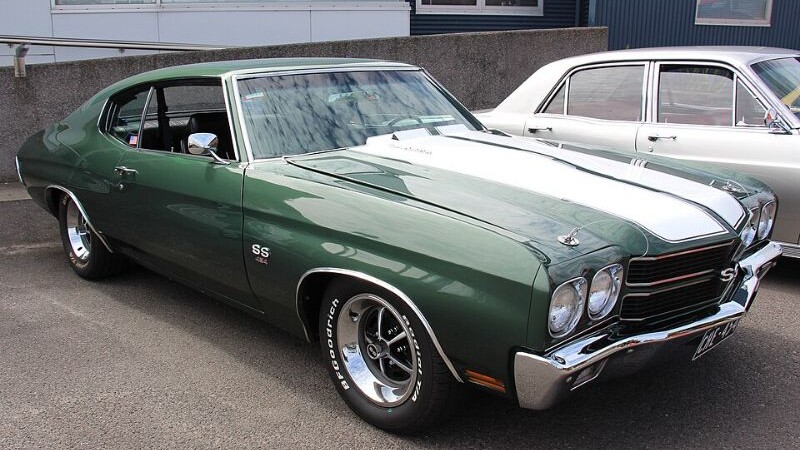
The car arrived on a trailer behind an old Ram 2500. It was Forest Green with black stripes, an SS hood, and a 454 that shook the glass in our office door.
“It looks finished already,” my painter, Luis, said.
Wade heard him.
“Look closer,” he replied.
Under fluorescent lights, the truth appeared. The paint was bubbling along both quarter panels. The trunk floor had pinholes. The driver’s door sagged, and the vinyl top hid rust around the rear window.
Wade wanted the work done properly, but not perfectly.
“No trailer queen,” he told me. “I want her to drive it.”
“Who’s her?”
He looked toward the car instead of answering.
My shop sits south of Tulsa near a row of welding suppliers and transmission rebuilders. We had a nine-month waiting list. Wade had been on it for seven.
He paid a $12,000 deposit by cashier’s check and brought two plastic tubs containing labeled fasteners, original trim, receipts, and a service manual held together with duct tape.
On top was an envelope marked For Emily—after the keys.
“Keep that in the office safe,” he said.
“Should I call Emily when we’re close?”
“I’ll handle it.”
We stripped the car to bare metal, cut out the rot, and found an old repair behind the passenger quarter made with brazed sheet metal and body filler nearly an inch thick.
Wade visited every other Friday at 4:30.
He never stayed more than twenty minutes.
He brought black coffee, asked precise questions, and ran his hand along every repaired seam. He knew torque specs, paint codes, and the difference between original and reproduction clips.
“Motor pool?” I asked once.
“Twenty-four years,” he said. “Then city buses.”
As the months passed, he told me pieces of the Chevelle’s history.
He bought it in 1983 for $3,600 after returning from Germany. His wife, Karen, hated the loud exhaust but loved the green paint. Their daughter Emily learned to drive in it in an empty high-school parking lot.
“She smoked the clutch?” I guessed.
“Automatic,” he said. “She took out three cones and blamed the steering.”
He almost smiled.
Then, during one visit, I asked when Emily had last seen the car.
Wade stared at the bare shell on the rotisserie.
“Twelve years ago.”
He offered nothing else.
The restoration took eleven months. We rebuilt the door hinges, repaired the trunk, replaced the vinyl top, and matched the original green using paint from inside the glovebox door. The big-block needed only gaskets, a carburetor rebuild, and a cooling-system overhaul.
Wade approved every invoice within a day.
Six weeks before completion, his checks began arriving from a law office instead of his home address.
I called him.
“Just paperwork,” he said. “Keep going.”
Pickup was scheduled for Saturday, October 14, at ten in the morning.
Wade asked us to leave the black factory wheels on the car and put Karen’s old Tulsa Drillers keychain on the ignition key.
“And the envelope?” I asked.
“On the passenger seat.”
Friday afternoon, we rolled the Chevelle outside for final photographs. The sunlight made the green paint look almost black until the curves caught it.
Luis stood beside me with his arms folded.
“He’s going to cry,” he said.
Wade did not arrive Saturday.
At 10:30, I called his cell. Straight to voicemail.
At noon, I called the number on the checks. The receptionist transferred me to an attorney named Rachel Boone.
There was a long silence after I explained why I was calling.
“Mr. Sullivan is at St. Francis Hospital,” she said. “He was admitted Thursday night.”
“Is he okay?”
“You need to speak with his daughter.”
Emily arrived at the shop forty minutes later wearing hospital scrubs beneath a denim jacket. She looked exhausted and angry.
“I was told there was a car,” she said.
I lifted the door to the paint bay.
She stopped walking.
For several seconds, the only sound was the ventilation fan winding down.
“He kept it,” she whispered.
Emily told me the part Wade never had.
After Karen died, father and daughter argued about the house, the funeral, and a thousand smaller griefs that had nowhere to go. Emily moved to Dallas. Wade responded by becoming more stubborn and less reachable.
The final break came when Emily asked to sell the Chevelle to pay part of her son’s medical bills.
Wade refused.
“I thought he chose a car over us,” she said.
I brought the envelope from the safe.
Inside was a handwritten letter, the restored title signed over to Emily, and a stack of canceled cashier’s checks.
The checks totaled $38,000.
They had been paid anonymously toward her son’s hospital account over three years.
The letter explained why Wade kept the Chevelle.
Karen had made him promise that their daughter would receive it when he could no longer drive. He believed selling it would break the last promise he had made his wife.
He also believed admitting the promise would sound like an excuse.
So he paid the bills quietly, kept the car, and let Emily believe the worst.
“That is the most Dad solution possible,” she said, wiping her face. “Fix everything except the conversation.”
Wade had suffered a heart attack, but he was awake.
With the hospital’s permission, we loaded the Chevelle into our enclosed trailer and parked it beneath his third-floor window. Luis held a polished shop light over the hood while Emily called her father.
From the sidewalk, I could see Wade’s hand lift against the glass.
Emily stayed on the phone with him for almost an hour.
Three weeks later, she returned to the shop with Wade in the passenger seat of her SUV.
He walked slowly with a cane, but he walked.
I handed him the keys.
He shook his head and pointed to Emily.
She sat behind the wheel. Wade lowered himself into the passenger seat. The 454 started on the second turn and settled into a deep idle that filled the whole row of shops.
“Steering still bad?” he asked.
Emily laughed and put the car in gear.
They drove six miles to the same high-school parking lot where she had once hit three cones.
This time, Wade brought two folding chairs.
They stayed until sunset.
Story note: This is an original dramatized automotive story created for entertainment.
Featured image: “1970 Chevrolet Chevelle SS454,” photographed by Sicnag, via Wikimedia Commons (CC BY 2.0). Image cropped for display.