I had already agreed on a price for my grandfather’s old Ford 5000
tractor when my daughter stopped me from selling it.
Two thousand five hundred dollars.
At the time, it seemed reasonable.
The tractor was old. Paint faded. Several seals leaked. Tires weathered.
And the PTO had developed a problem that made it almost useless for the
jobs I expected it to do.
My name is Brian Keller.
Our family farm isn’t large. We grow hay, keep cattle and maintain
enough acreage that an old utility tractor can still earn its place.
The Ford 5000 had been on the farm longer than I had.
Grandpa bought it used. Dad ran it. Then I inherited responsibility for
keeping it alive.
For years, it handled mowing, auger work and light chores.
Then the PTO began slipping under load.
With nothing attached, it appeared normal.
Under light work, it could fool you.
Hook up the brush cutter and push into heavy grass, and the problem
appeared.
I adjusted what was appropriate externally. No miracle.
A neighbor offered $2,500 for it as a project.
I said yes.
My daughter Emily heard that evening.
She was twenty and studying agricultural equipment technology.
“You sold Grandpa’s Ford?”
“Almost.”
“Give me Saturday.”
“For what?”
“To look at it.”
“I looked at it.”
“You adjusted it. That isn’t the same thing.”
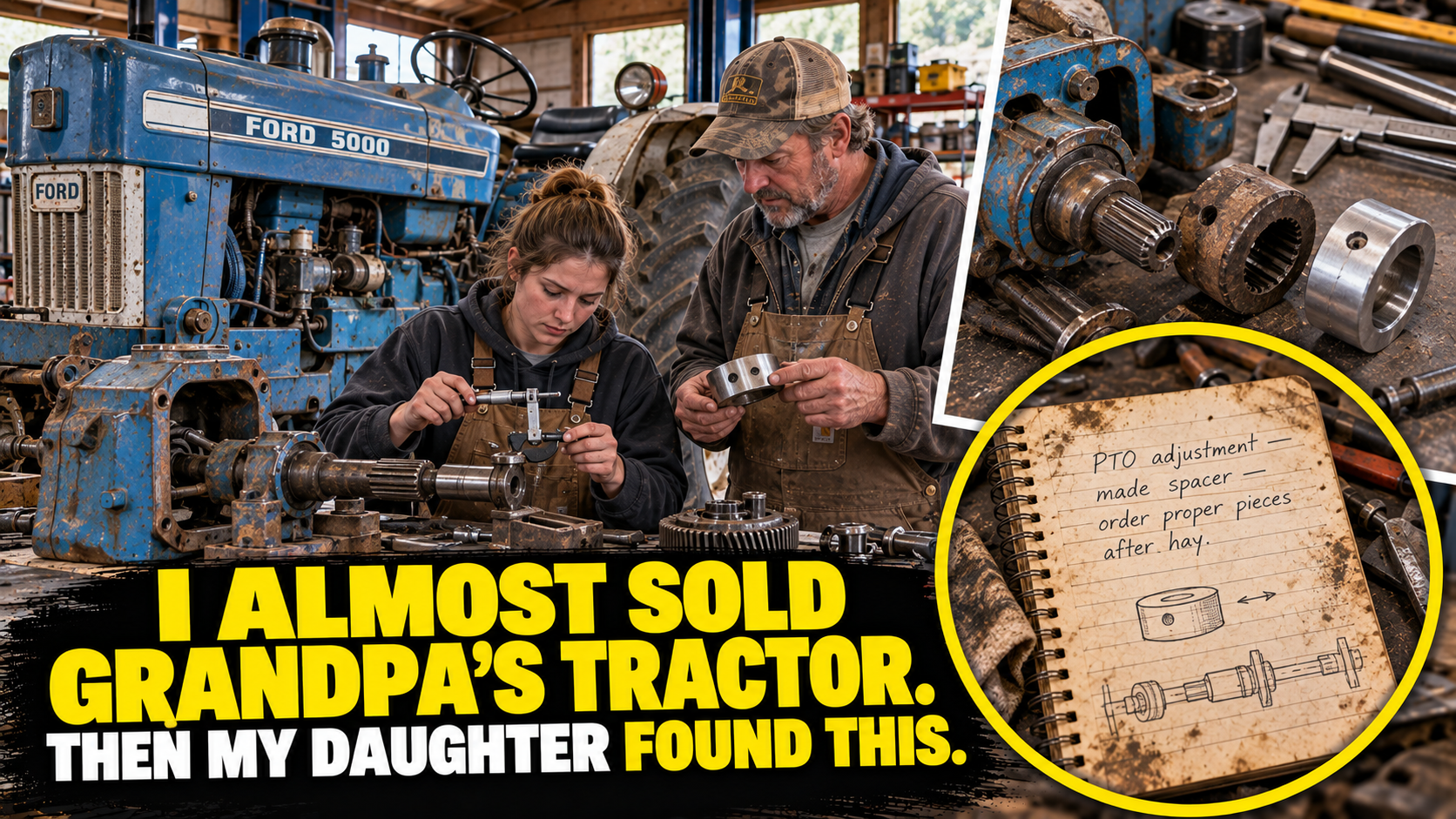
Saturday morning, she rolled it into the shop.
We began with service information rather than guesses.
Pressure checks. Linkage inspection. Measurements.
Behind an inspection area she found something unusual.
A linkage component appeared opposite from what the diagram suggested.
Beside it was a homemade steel spacer.
Emily held it up.
“Who made this?”
I knew.
Grandpa marked fabricated pieces with two punch dots.
The spacer had those marks.
Emily initially assumed the homemade part caused the PTO problem.
That would’ve been the easy story.
Except the evidence didn’t support it.
The spacer wasn’t broken or crushed.
It had been machined reasonably well.
And the tractor had worked for years with it.
Emily measured it using Grandpa’s old micrometer.
Then she measured related wear.
“The spacer isn’t the mistake,” she said.
She pointed to another worn component in the engagement mechanism.
Wear had progressed far enough that the system could no longer maintain
the geometry it needed under load.
The homemade spacer had likely been Grandpa’s attempt to compensate for
earlier wear.
Maybe proper parts weren’t available immediately.
Maybe money was tight.
Maybe he needed the tractor working that afternoon.
We found an old notebook in Dad’s cabinet.
One entry said:
PTO adjustment. Made spacer. Order proper pieces after hay.
No later entry showed the proper pieces being installed.
Emily laughed.
“After hay lasted thirty years.”
We called my neighbor.
The sale was off for now.
We sourced correct replacement components, inspected related wear,
corrected the linkage according to proper service information and
removed the old compensation that was no longer appropriate.
Then we tested.
First unloaded.
Then under controlled load.
Finally with the brush cutter.
The PTO held.
Emily drove into the same heavy patch that had made it slip before.
The cutter stayed at speed.
She turned around smiling.
“You were saying something about $2,500?”
“Drive the tractor.”
The repair didn’t make the Ford valuable beyond reason.
It was still an old Ford 5000.
Still leaked in places. Still needed tires eventually. Still had faded
paint.
A successful repair doesn’t transform an old machine into treasure.
It makes it useful again.
Weeks later Emily used the tractor for a school project about old field
repairs.
Grandpa’s spacer became her example.
He hadn’t defeated a safety system or welded something that should never
be welded.
He machined a simple piece to compensate for wear and finish the season.
The mistake wasn’t making the spacer.
The mistake was forgetting to return later and finish the repair
correctly.
Emily cleaned the spacer and mounted it on a small board with Grandpa’s
notebook entry.
At the bottom she wrote:
TEMPORARY — APPROX. 30 YEARS.
Grandpa would’ve laughed.
The Ford still works on our farm.
We don’t pretend age doesn’t matter.
But it runs the cutter and handles the auger.
Every time Emily operates it, I see three generations in one machine.
Grandpa’s punch marks.
Dad’s notebook.
My daughter’s measurements.
I nearly sold the tractor because I thought a slipping PTO meant the old
machine had reached the point where repairs no longer made sense.
Someday that point will come.
But not that day.
That day, the Ford needed somebody patient enough to find the difference
between the old repair everyone could see and the worn part nobody had
measured.