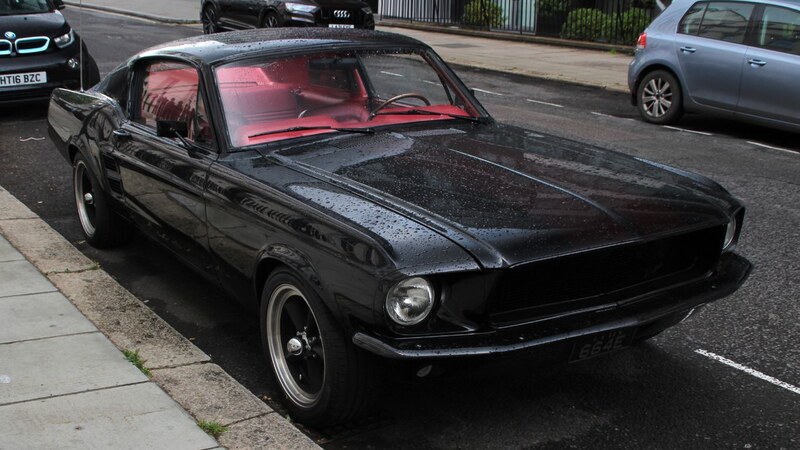
My neighbor Ruth asked me to start her husband’s 1967 Mustang because she was finally ready to sell it.
The car had been sitting in their detached garage outside Richmond, Virginia, since Paul died two winters earlier.
It was black with a red interior, a 289 V8, and water spots still dried across the hood from the last time he washed it.
“I need the garage back,” Ruth said.
She did not sound convincing.
I work as a service manager at a Ford dealership, but Paul had always handled his own cars. He rebuilt the Mustang’s front suspension on jack stands, tuned the carburetor by ear, and kept every receipt in a metal cookie tin.
His granddaughter, Lucy, used to sit on a milk crate and hand him wrenches.
Then Lucy left for college in Arizona after an argument nobody in the family would explain.
She did not return before Paul died.
The Mustang’s battery was dead and the gasoline smelled old. I disconnected the fuel line, pulled the plugs, fogged the cylinders, and turned the engine by hand before trying the starter.
Ruth watched from the doorway with her arms folded.
“He would tell you the plug wires are routed wrong,” she said.
“They’re routed his way.”
“Exactly.”
By Saturday afternoon, the oil was changed, fresh fuel was feeding the carburetor from a safe service can, and the V8 was ready to try.
I turned the key to accessory.
The old cassette deck clicked.
A man’s voice came through the single dash speaker.
“Lucy, if you found this, your grandmother finally let somebody touch my radio.”
Ruth dropped the shop towel she was holding.
The tape hissed, then Paul laughed.
“Rewind it,” she said.
I pressed stop. The cassette would not eject.
We removed the radio carefully and carried it to my workbench. The belt inside the cassette mechanism had turned gummy, but the tape itself was intact.
I borrowed a working player from a friend who restores home stereos.
Paul’s recording was twenty-three minutes long.
He made it three weeks before he died.
At first, he talked about the Mustang: the soft second-gear shift, the fuel gauge that lied below a quarter tank, and the exact place to hit the glovebox when it rattled.
Then he explained the argument.
Lucy wanted to study automotive engineering. Paul wanted her to stay in Virginia and join the family’s accounting business.
When she accepted a scholarship in Arizona, he told her she was wasting her future.
She told him the Mustang mattered more to him than she did.
Neither one called back.
On the tape, Paul admitted he had been wrong.
“I knew how to fix cars,” he said. “I thought that meant I knew how to fix people. Mostly, I just tightened things until they broke.”
Ruth sat at the workbench and covered her face.
Paul had recorded the message after learning his heart condition was worse than he had told the family.
He asked Ruth to give Lucy the Mustang after graduation.
“Not because she owes me forgiveness,” he said. “Because I owe her the choice.”
Ruth had never heard the tape. She rarely used the radio, and Paul had left the cassette paused midway through the first second.
“I almost sold it to a dealer yesterday,” she whispered.
Lucy was now twenty-four and working for an electric-vehicle supplier in Phoenix.
Ruth called her that evening.
The conversation lasted nine minutes.
Most of it was silence.
Two weeks later, Lucy flew home.
She entered the garage without taking off her coat. When she saw the Mustang, she touched the same chip in the driver’s door edge she had tried to hide with black nail polish at sixteen.
“He never fixed that?” she asked.
“Said it was your first body repair,” Ruth answered.
We played the tape from the beginning.
Lucy stood until Paul described the glovebox rattle. Then she sat in the driver’s seat and stared through the windshield.
When the recording ended, she did not speak for a long time.
“Can it run?” she finally asked.
“That was the plan.”
The engine fired after four revolutions. It coughed once through the carburetor, cleared its throat, and settled into the uneven idle of an old small-block that had been waiting too long.
Lucy laughed and cried at the same time.
She did not ship the Mustang to Arizona.
She also did not let Ruth sell it.
Instead, she rented a small storage space near Richmond and came home once a month through the summer. We replaced the brake hoses, rebuilt the wheel cylinders, installed new tires, and repaired the cooling system.
Lucy did most of the work herself.
At the end of August, she drove Ruth to the Blue Ridge Parkway.
The original radio stayed in the dash. The repaired cassette remained inside it.
Lucy copied the recording to three digital files, but she said the old tape sounded better.
“It makes him sound like he’s still in the garage,” she told me.
Sometimes an old car carries more than a family expects.
That Mustang carried one last conversation until they were ready to hear it.
Story note: This is an original dramatized automotive story created for entertainment.
Featured image: “1967 Ford Mustang 5.0L,” photographed by Calreyn88, via Wikimedia Commons (CC BY-SA 4.0). Image cropped for display.