The woman who walked into my shop did not ask me to beat another mechanic’s price.
She put a $6,200 estimate on my counter and said, “Tell me if this car is worth fixing before I borrow the money.”
Her name was Danielle Reed.
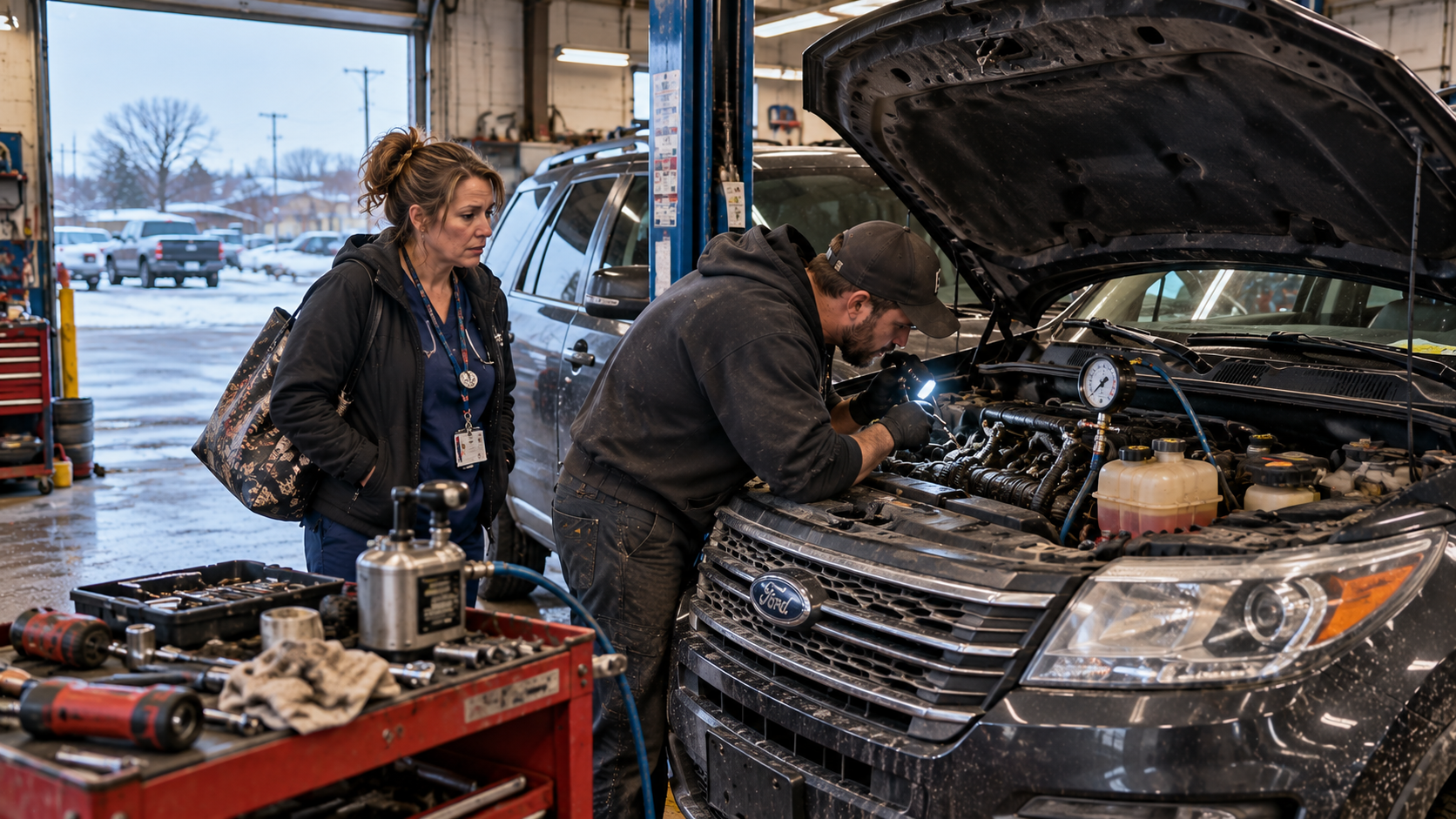
Danielle was 44, worked as a home-care nurse in Louisville, Kentucky, and drove a 2017 Ford Explorer with the 3.5-liter V6.
The Explorer had 146,000 miles.
It was not pristine.
The driver’s seat showed years of getting in and out with a work bag. There were scratches around the rear bumper, an umbrella under the passenger seat, and a plastic organizer in the cargo area filled with supplies Danielle carried between patient visits.
The SUV earned its keep.
That was why the cooling problem had become a financial problem so quickly.
It started with a smell.
Danielle noticed a faint sweet coolant odor after starting the Explorer on a cold morning.
She looked under the vehicle.
Nothing.
A few days later, she smelled it again.
Then, while sitting in traffic, the temperature gauge climbed higher than normal.
She shut the engine off before it reached the red.
After the engine cooled, she checked the reservoir and found the coolant low.
She added coolant.
The level dropped again over the following days.
Another repair facility inspected the Explorer and documented coolant loss. Because the exact source and extent of the problem had not yet been fully established, their paperwork included a repair path that could exceed $6,200 if testing confirmed major internal engine damage or extensive cooling-system work.
Danielle focused on one number.
$6,200.
She applied for a personal loan.
By the time she arrived at our shop, the loan had been approved.
“I don’t want another payment,” she said. “But I can’t miss work.”
I read the estimate.
Then I told her something she did not expect.
“Don’t sign anything for the loan today.”
She looked suspicious.
“Because you think it’s cheaper?”
“No. Because I haven’t diagnosed it.”
That answer did not comfort her.
But it was the only answer I could defend.
Coolant loss can be simple.
It can also be expensive.
A hose can leak.
A radiator can leak.
A reservoir can crack.
A thermostat housing can fail.
A water pump can leak.
An engine can develop an internal problem.
And sometimes a leak only appears under temperature, pressure, or operating conditions that do not exist while the vehicle sits cold in a bay.
We started with a cold cooling-system pressure test.
The system held well enough that there was no dramatic stream of coolant hitting the floor.
We inspected the accessible hoses, radiator area, reservoir, connections, and visible parts of the engine.
Nothing explained the amount Danielle said she had been adding.
That did not mean the coolant was disappearing magically.
It meant we had not reproduced the leak yet.
We checked the engine oil for obvious evidence of coolant contamination.
Nothing immediately supported a conclusion that the crankcase was full of coolant.
We also evaluated whether combustion gases were entering the cooling system.
Again, the results did not give me evidence to condemn the engine.
That was good news.
It was not a diagnosis.
We brought the engine up to operating temperature.
The cooling fans cycled.
Pressure increased.
We inspected again.
Still no dramatic puddle.
Then one of my technicians used a light and inspection mirror around an area that was difficult to see clearly from above.
He called me over.
There was a faint dried residue.
Not a river.
Not a fresh green puddle.
A trail.
We cleaned the area we could reach and continued testing.
After another heat cycle, the evidence began to return.
Now we had a direction.
On this engine configuration, the water pump is not sitting out in the open like it is on many older engines.
The location and design make a water-pump problem much more serious to investigate and much more labor-intensive to repair.
A leak in that area also raises an important concern.
Where is the coolant going?
If the failure progresses in the wrong way, coolant contamination can create consequences far beyond replacing a pump.
That was the second question in Danielle’s repair.
We had evidence of a pump-area leak.
We still needed to determine whether the engine had suffered additional damage.
We inspected the oil more carefully.
We looked for contamination.
We evaluated the engine’s operation.
We checked the cooling system again.
We considered Danielle’s history: intermittent coolant smell, gradual loss, one temperature event that she responded to quickly, and no report of continuing to drive the vehicle severely overheated.
The evidence did not support telling her the engine was destroyed.
But the water-pump leak was real.
And it needed to be addressed.
I called Danielle.
“Is it the engine?” she asked.
“We have not found evidence that you need an engine.”
I could hear her exhale.
Then I added the part she needed to hear.
“But this is not a cheap water-pump job.”
Access required significant labor.
The repair involved more than bolting on one inexpensive part.
We discussed replacing the failed water pump and the related components and seals that made sense to address while the engine was already opened to that extent.
We discussed fresh coolant, an oil and filter change as a precaution based on the nature of the failure, proper reassembly, and verification.
I also told her we would inspect carefully as the repair progressed.
If we found evidence of damage that changed the plan, I would stop and call her.
That was when Danielle told me she had already moved the loan money into her bank account.
She had been so convinced the $6,200 repair was coming that she wanted the funds ready.
I gave her our estimate for the confirmed work.
$3,480.
That was still a serious bill.
Danielle did not cheer.
People on the internet sometimes imagine that hearing a repair is thousands less than a worst-case estimate causes customers to celebrate.
Usually they just look relieved and tired.
“Three thousand four hundred eighty?” she repeated.
“Yes.”
“And you think it’s worth doing?”
I told her I could not decide that for her.
I could give her facts.
The Explorer had 146,000 miles.
We had not found evidence requiring an engine replacement.
The transmission was operating normally during our checks.
The vehicle had normal age-related wear.
She knew its service history.
She depended on it for work.
Then I told her to compare the repair cost with the cost and risk of replacing the vehicle.
Danielle authorized the repair.
Once disassembly began, we were able to inspect the affected area more directly.
The water pump showed clear evidence of leakage.
The surrounding evidence matched what we had seen during testing.
Most importantly, we did not find the kind of contamination that would have forced me to call Danielle and change the conversation to engine replacement.
We replaced the water pump and the related components included in the approved repair plan.
We cleaned the accessible affected areas.
We changed the engine oil and filter.
We filled and bled the cooling system correctly.
Then we started the Explorer.
No shortcuts.
We let it reach operating temperature.
We monitored temperature behavior.
We checked for leaks.
We let it cool.
Then we checked the level again.
The next morning, we performed another cold inspection.
After that, we road-tested it through city traffic because that was where Danielle had seen the temperature rise.
The gauge remained stable.
The heater output remained consistent.
No coolant smell.
No fresh residue.
No unexplained level drop.
The final invoice was $3,480.
That was the cost of the diagnosis and the repair we could support with evidence.
The original figure approaching $6,200 had represented a broader possible repair path if testing revealed major additional damage.
That additional damage was not confirmed.
When Danielle arrived, I showed her the old pump and explained why the location of the failure mattered.
She stared at the part.
“I thought a water pump was one of those couple-hundred-dollar repairs.”
“Sometimes it is.”
“And on this?”
I shook my head.
“Not with the labor involved.”
That was another important lesson.
The price of a component and the price of repairing the system are not the same thing.
A relatively ordinary component can be buried behind hours of labor.
Related seals, fluids, one-time-use items, cleanup, and verification also matter.
Danielle paid the invoice.
Then she pulled a white envelope from her purse.
Inside were five $100 bills.
“This is for the shop,” she said.
I handed it back.
She frowned.
“Why?”
“You just spent $3,480.”
“I borrowed more than that.”
“That doesn’t make the other money free.”
She laughed.
Then she told me what she had decided to do.
The personal loan had been approved for enough to cover the worst-case repair and leave a little cushion.
Now that she did not need all of it for the Explorer, she planned to immediately pay back the unused portion instead of treating it like extra spending money.
That was smart.
But there was another piece.
Danielle’s younger brother, Marcus, was 27 and had been trying to get steady work after several years of bouncing between warehouse jobs.
He liked cars.
He did basic maintenance for family members.
He had recently mentioned applying to an automotive training program but complained that he did not know whether he would actually like working in a shop.
Danielle pointed toward the service area.
“Can he come here for a day?”
I told her we could not put an untrained visitor into active repair work for safety and insurance reasons.
But we could arrange a short shop visit, let him observe from safe areas, talk with the technicians, and explain what the job was actually like.
“That would be worth more than the tip,” she said.
So that was what we did.
A couple of weeks later, Marcus came by.
He expected mechanics to spend all day swapping brakes and engines.
Instead, he watched a technician study a wiring diagram.
He watched another technician perform a smoke test.
He saw how much time went into documenting measurements, looking up procedures, and verifying a repair before a vehicle left.
At lunch, he asked questions about tools, training, certifications, starting pay, and how long it took to become genuinely good at diagnosis.
Nobody sold him a fantasy.
We told him the work could be physically hard.
Tools were expensive.
Rust was miserable.
Flat-rate systems could be stressful.
Modern diagnostics required constant learning.
But if he liked solving problems and working with his hands, there were paths forward.
Marcus eventually enrolled in a local automotive program.
Danielle sent us a photo months later of him wearing safety glasses in a school shop.
The $500 tip never went into our register.
The unused loan money went back toward the loan.
And the favor she asked for cost us almost nothing except a little time.
Danielle’s story had several mechanical lessons.
First, coolant loss should be investigated before repeated topping-off becomes a routine.
A small leak can become a large failure.
Second, no visible puddle does not mean there is no leak.
Some leaks appear only under heat and pressure. Others occur in locations where coolant evaporates, collects, or is difficult to see.
Third, a worst-case repair estimate is not a confirmed diagnosis.
The first shop had reason to warn Danielle that coolant loss on that engine could become expensive.
Our testing narrowed the problem and found no evidence at that time that the engine required replacement.
Fourth, repair cost is not just part cost.
Access can dominate a job.
A water pump may sound ordinary, but its location can turn replacement into a major labor operation.
Fifth, verification matters.
After cooling-system work, we did not simply fill the reservoir and send Danielle home.
We heat-cycled the vehicle, checked the level cold, inspected for leaks, monitored temperature, and road-tested it under the conditions that had worried her.
Finally, there is a financial lesson.
Danielle asked whether the Explorer was “worth fixing.”
A mechanic can describe the condition of the vehicle and the repair.
The owner has to weigh that information against replacement cost, debt, reliability needs, and personal finances.
For Danielle, spending $3,480 to keep a familiar paid-for vehicle working made sense.
For another owner with a different vehicle or financial situation, the answer could be different.
Several months later, Danielle returned for an oil change.
The coolant level was stable.
There was no new smell.
The temperature gauge behaved normally.
Before leaving, she showed me the photo of Marcus at school.
“You wouldn’t take my $500,” she said.
I told her I still thought that was the correct decision.
She smiled.
“Good. Because this ended up costing me more.”
I looked confused.
“Tools,” she said. “He discovered tools.”
Any mechanic with a toolbox knows exactly how that story ends.